
Selle postituse lugemiseks kulub umbes 9 minutit.

How to stand out in a crowded market – Brand Positioning 101

Positioning may sound like a fancy and slightly off-putting marketing buzzword, but it’s actually not that complicated. Positioning is how people perceive you before you have a chance to say anything. It’s the space you take up in someone’s head for yourself. Positioning isn’t your job title, logo or slogan.

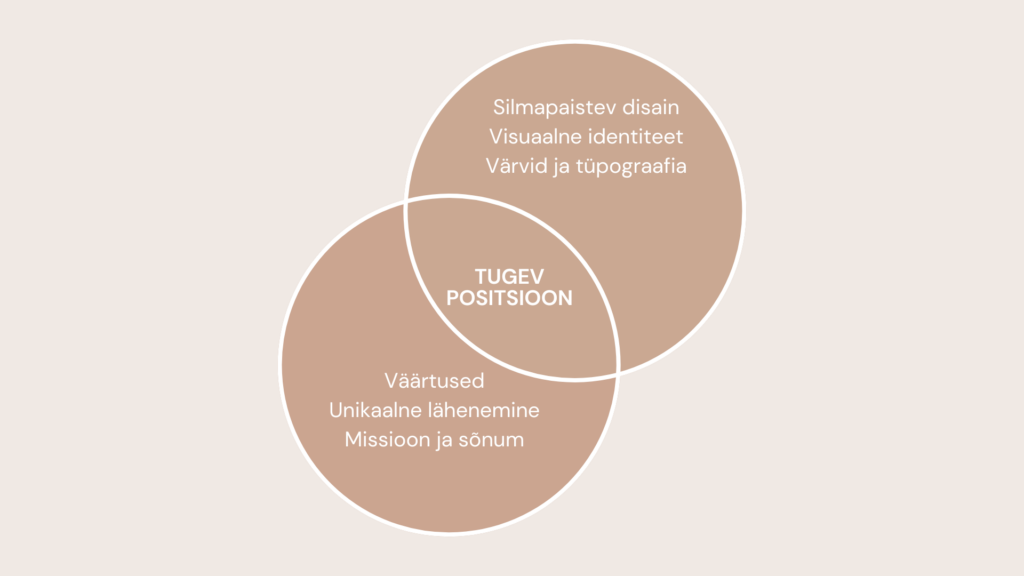
It’s a thought that people have from the moment they encounter your brand. You can shape this idea step by step if you have clarity on three things:

A few years ago, I was in a situation where I knew the quality of my work was good. I had great clients, good feedback and a strong portfolio. Yet every time I opened up social media, I saw others getting more attention than me – more followers, enquiries and clients. Even if the quality of their work was not as good.

I started to look into the reasons and realised that I was not doing anything directly wrong. I just wasn’t thinking about some important things. I believed that good work speaks for itself. I wasn’t paying enough attention to how my brand would look to someone seeing me for the first time.

It’s ironic, because as a brand designer, I’m constantly talking to my clients about the importance of clarity, first impressions and strategy, and we apply these principles in our daily work.

In my case, I didn’t really implement all of it. So I blended in. I had the skills and the results, but lacked a clear position. In a market where there are a lot of players, that doesn’t work well.

If you don’t take control of your brand positioning, people will put you where they feel comfortable. More often than not, this means being passed over, compared to the wrong competitors, or assumed to be ‘like everyone else’.

Today I’m writing about what I wish I’d known earlier – how to position yourself so clearly that the right people understand you immediately and others move on calmly because they’re not your clients.
Why clarity before quality?

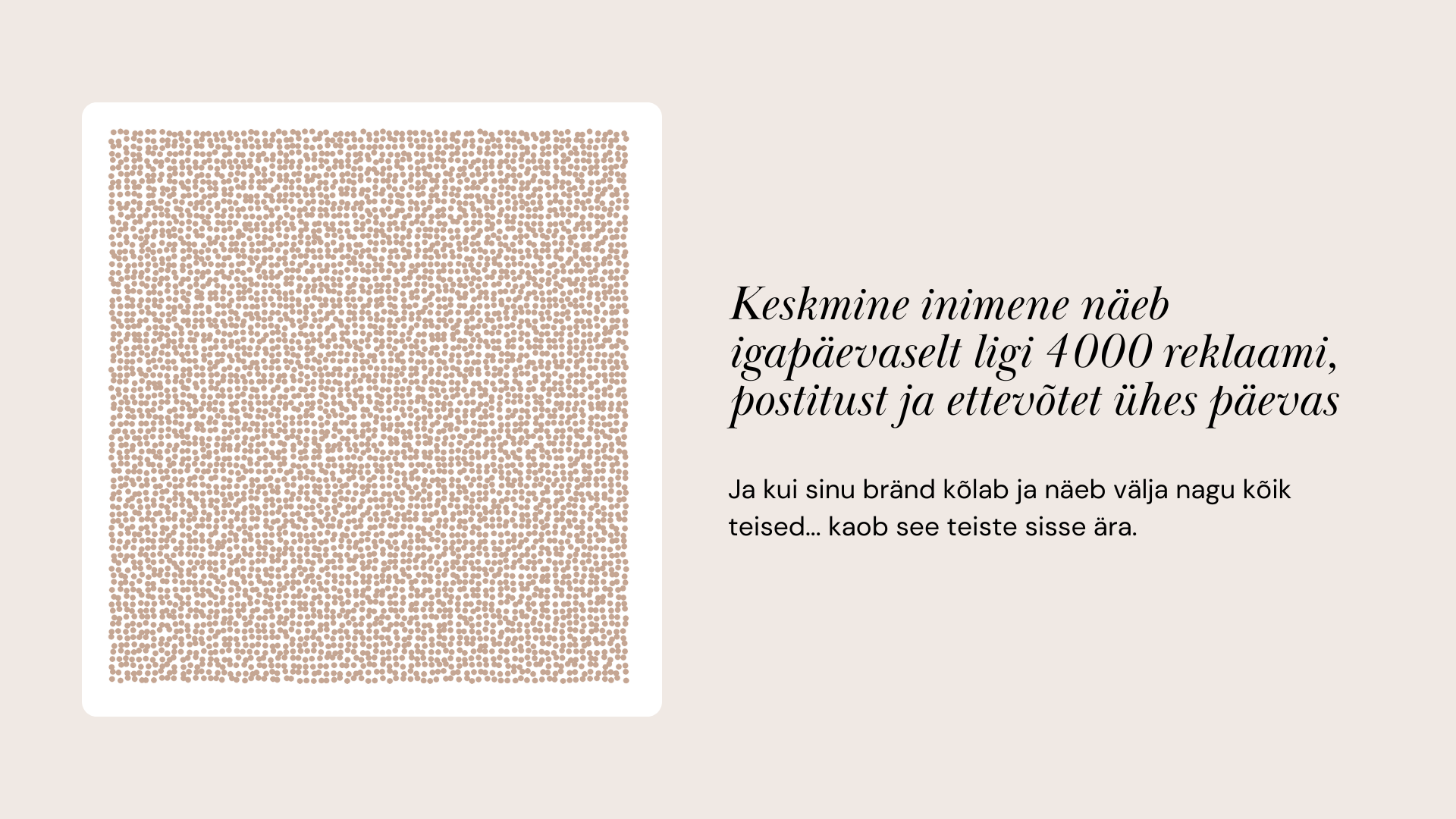
A good service or product is important, but in the information age, clarity wins. You may be very strong in your field, but your competitor gets more customers simply because his message is clearer. People don’t always choose the best solution, but the one that seems the most credible and easy to understand.

If you think about how much information a person consumes every day, it makes sense. The brain makes quick decisions. If something is obscure, general or too complex, the prospect moves on. Creating clarity is at the heart of positioning.

With positioning in place, you will not be seen as “just another” service provider or e-shop. You are seen as the right choice for them.

And this brings us to a frequent question.

How do you find your unique differentiation when it seems that everyone is offering the same?

I see a lot of talented and smart people in my circle who say:
“I’m good at what I do, but there are so many good ones.”
“I don’t have a special story. I’m just good at what I do.”

This is very common. Working with more than a hundred entrepreneurs, I have seen that people are often too close to their strengths and idiosyncrasies to notice them clearly. What seems ordinary to you may be the ‘wow’ someone else is looking for.

You don’t have to invent your differentiation, you have to find it.

Three places where unique differentiation usually comes from

Ask yourself:

  • What do clients always thank you for?
  • What problems do people bring to you again and again?
  • What’s something you do naturally that others find hard?
  • What opinion do you have about your industry that goes against the grain?

One of my principles, which people have noticed time and again, is how I treat my competitors.I don’t believe in tearing others down. We can all do business while being kind to others. I believe that there are right clients for everyone, mine will come to me, yours will come to you.

That belief, which felt so normal to me, turned out to be a core part of my edge. It’s part of why people trust me. Why they refer others. Why they come back.

Another example. I thought that every designer sees a vision of a website or a logo, a color palette in their head while talking with their clients… Turns out they don’t. It’s a me thing. For me, when I start designing, I mostly get the first version done quickly, because I know what I want to see there.

It’s not just about what I do, but how I see this work. And that’s something every one of us has: a perspective, a philosophy, a way of showing up that sets us apart. Your edge probably isn’t something you need to invent.
It’s something you’ve already been living.

A clear message is the foundation of a strong brand

You can be exactly what someone needs, but if your message is muddled or generic, you won’t be in a strong position. People need to be able to answer three questions quickly:
– Who do you help
– What you help them do
– And why they should trust you to do it

This is where the gap between a good brand and a very strong brand often emerges. You know what you’re offering and who it’s for. But how it looks on your website, in your Instagram bio or in your LinkedIn headline may not be as clear.

When your ideal client comes to your website, will they see a lot of you there? Or do they get the feeling that it’s for them?

They talk too much about themselves and their business, services, products, so they forget that they’re not the star here. Client is.

You have to understand which problem are you solving for your client. Ask your past clients or cooperation partners:
– What made you choose me?
– What was going on in your life or business when you reached out?
– What was the biggest shift you experienced from working with me?

Based on these answers, you can formulate a simple framework:
I help [specific person] do [specific thing] so they can [specific outcome].

But of course, even the best message can get lost if your brand looks off

Even the strongest message can get lost if the visuals give the wrong impression. When your text says one thing, your design says another, and your tone adds a third layer, people feel confused and confusion doesn’t create trust.

If visuals are created only to “look nice,” they won’t do much for your business. Design should support your strategy and guide your audience toward the right decision, often on a subconscious level. Strategy, messaging, and visuals need to work together.

You can’t have strong positioning if one of those three is missing.

When we land on a website or scroll past a social media post that looks thrown together — fonts and colors don’t match, images feel random or blurry — our brain makes a quick judgment. We decide in seconds, mostly without realizing it.

Visuals aren’t decoration. They’re a key tool for building trust. People don’t always pay for the “best” solution, they pay for the one that feels the most credible.

Alignment between visuals and brand voice

A brand often loses its way when the visuals, message, and tone don’t match. For example: a soft, pastel design paired with copy that sounds formal and corporate like a law firm. Or the opposite: bold visuals paired with a message that feels too gentle.

Your brand personality should come through at every touchpoint.
If you’re bold, be bold.
If you’re calm and supportive, be that.
If you’re playful, let it show.

A brand can evolve over time, but its foundation should stay stable.

What to take away

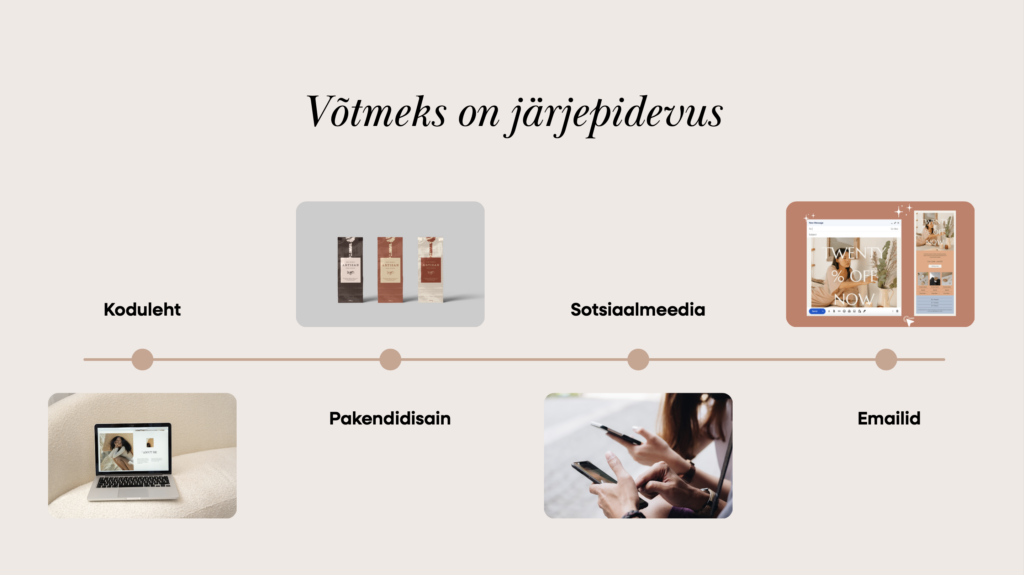
You don’t need to be louder or overcomplicate things. A brand needs consistency: in your message, your tone of voice, and your visuals. And it needs clarity around who you are, what you offer, and why it matters.

When your positioning is clear, the right people start recognizing you. You don’t blend into the crowd, and you don’t have to chase clients. Instead, you naturally attract those who already see your value and you avoid exhausting price negotiations and collaborations that don’t support you.

Three simple steps you can do today

You don’t need to change everything at once, just don’t let it sit untouched for years either. Positioning is a creative process and it takes time. But that time pays off many times over, because clarity keeps working for you long after you’ve done the work.

If this made you think that your message could be sharper, your positioning clearer, or your visuals more strategic, it might be time to revisit it intentionally. You can book a consultation, sometimes one clear conversation is enough to see your brand from a completely new perspective.

Cathy Kask

Strategic brand and web designer